P6 Schedule Optimization using OR-Tools
.jpg)
Kazimir Malevich. "Portrait of Ivan Vasilyevich Klyun (Improved portrait of Klyun (Builder)"
Resource Optimization: From CPLEX to OR-Tools
The Equilibrium Project:
- Live Demo: Streamlit web-app
- Source Code: GitHub
In the previous posts, I discussed two related but initially independent topics:
- parsing Primavera P6 (XER) files using the Python library
xerparser - building schedule optimization models using CPLEX
The natural next step was to combine these approaches into a single applied project: resource optimization directly on top of P6 schedules. At this stage, however, it became clear that the limits of the CPLEX Community Edition are too restrictive for this type of problem, and since the commercial version was not available to me at the time, I decided to switch to Google OR-Tools. As a result, the project evolved into a prototype called Equilibrium.
In this article, I explain why this transition was necessary, how the optimization model is structured, and which scenarios have been implemented.
The Problem: Limitations of CPLEX Community Edition
CPLEX works very well for educational and small-scale scheduling problems. However, when moving to bigger XER files exported from Primavera, the constraints of the Community Edition (1000 variables and 1000 constraints) become noticeable. As long as access to the commercial version is not available for me, this naturally led me to look for an alternative solver better suited for working with real project data.
Why OR-Tools
As an alternative, Google OR-Tools (CP-SAT) was selected:
- fully open-source
- well suited for discrete scheduling problems
-
native support for:
- interval variables
- precedence constraints
- resource capacity constraints
- good scalability on scheduling benchmarks
Overall Architecture
The Equilibrium project implements a full processing pipeline for Primavera P6 schedules:
XER (Primavera P6)
        ↓
   xerparser
        ↓
   pandas / preprocessing
        ↓
   OR-Tools (CP-SAT)
        ↓
 Streamlit + visualization
Technology stack:
- xerparser — XER file parsing
- pandas — data transformation and preparation
- OR-Tools (CP-SAT) — optimization engine
- Streamlit — UI and scenario execution
- matplotlib — schedule and resource visualization
This allows P6 schedules to be passed directly into the solver without manual intermediate transformations.
Implemented Optimization Scenarios
The current version includes two scenarios that reflect different management perspectives.
Scenario 1. Automatic Resource Assignment
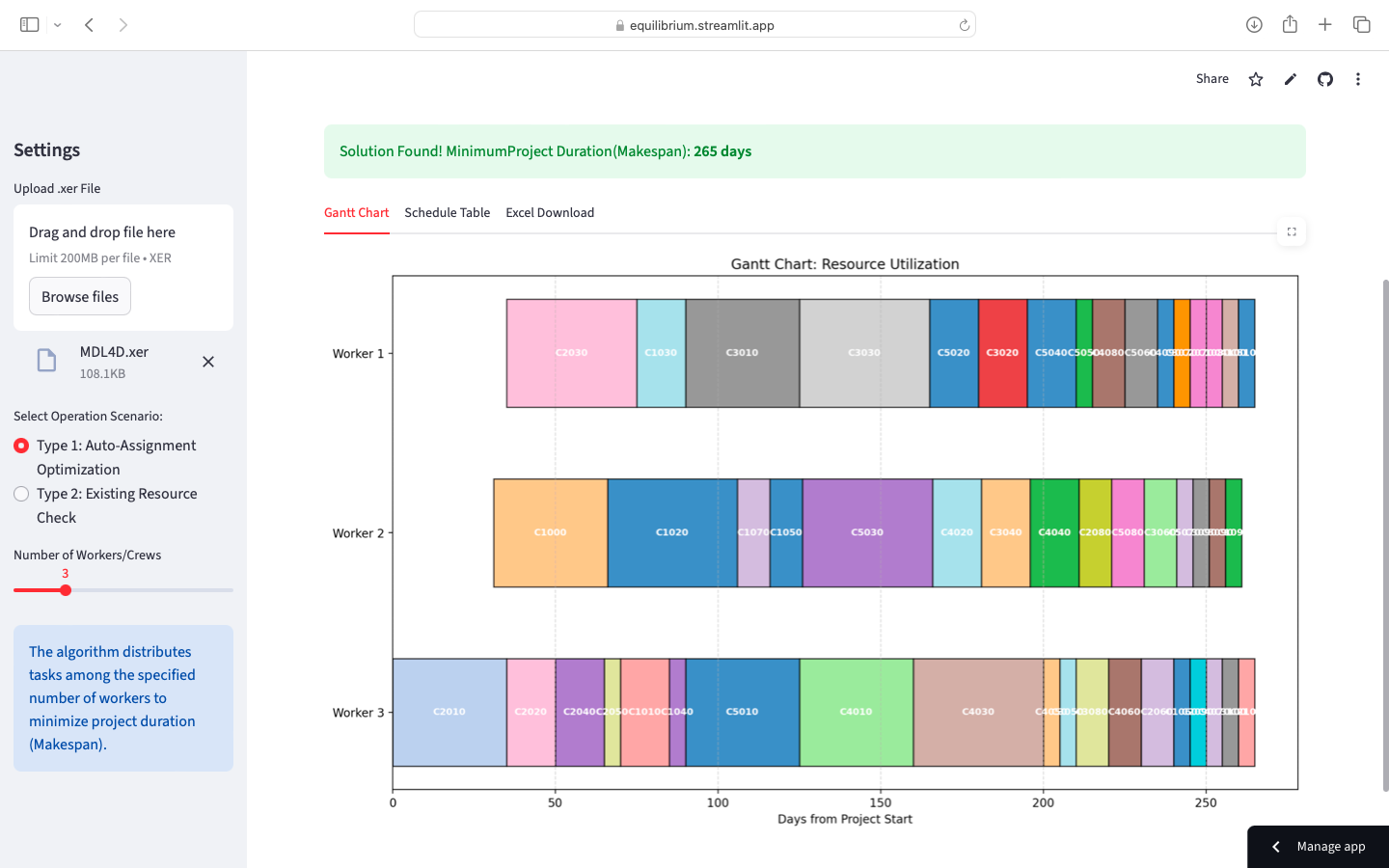
Problem statement
- a set of activities with durations and precedence constraints
Ninterchangeable resources- objective: minimize total project duration (makespan)
Model characteristics
- all activities are automatically assigned to resources
- each resource can process only one activity at a time
- all logical dependencies are respected
- the solver determines both the assignment and execution order
This scenario is useful for estimating the theoretical minimum project duration given a fixed number of crews.
Scenario 2. Optimization Within Existing Resource Groups (Sub-Crews)
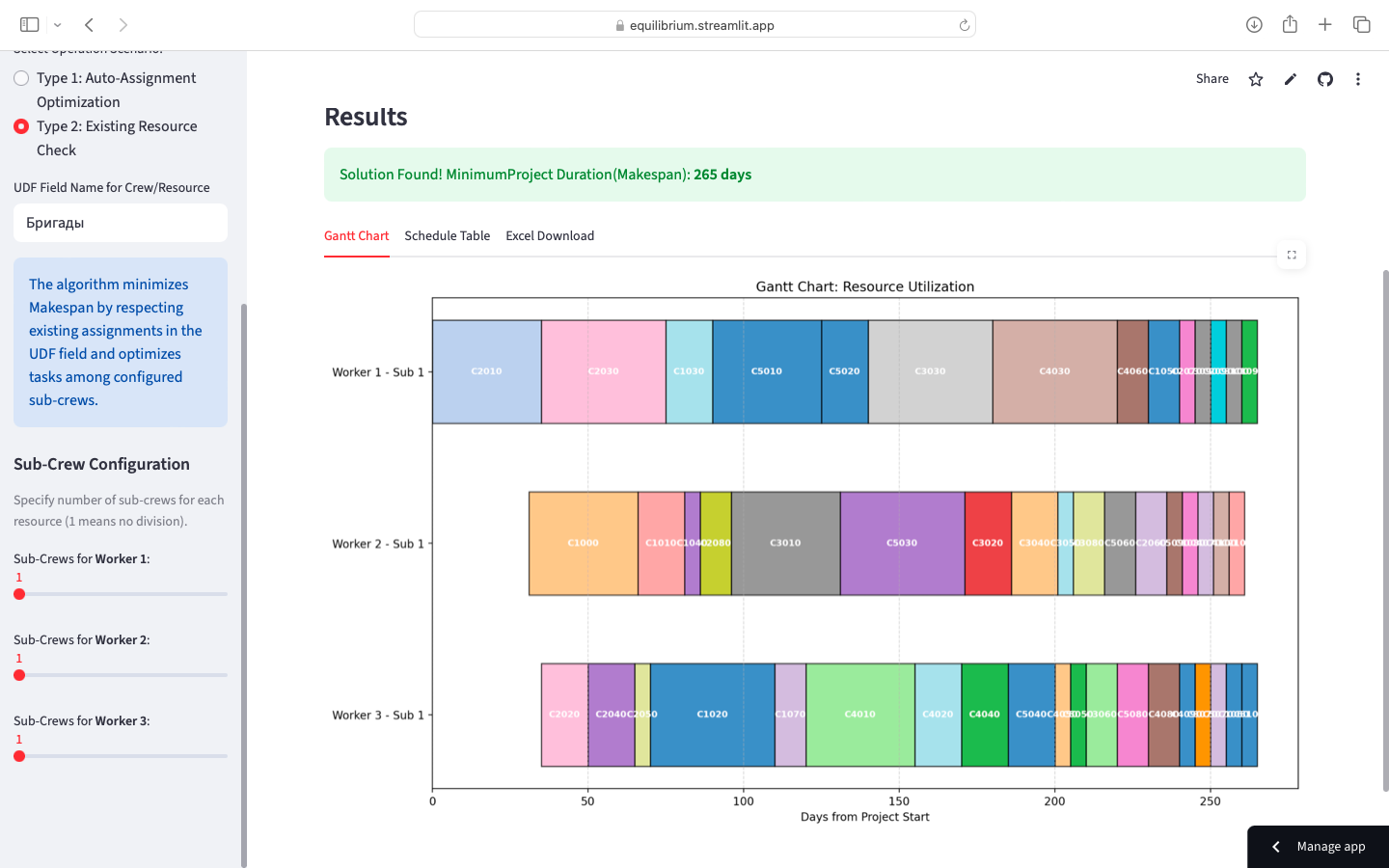
This scenario is closer to real Primavera workflows.
Initial setup
- resources are already defined in Primavera
- activities are grouped by a UDF (crew / zone / contractor)
- each group is effectively executed sequentially
Core idea
Each resource group is split into N parallel Sub-Crews, while:
- preserving the original schedule structure
- performing optimization locally within each group
- introducing controlled parallel execution
Practical meaning
The model can answer questions such as:
- what happens to the schedule if a second sub-crew is added?
- where do conflicts between precedence logic and resource capacity arise?
- does increasing resources help, or is the schedule precedence-bound?
Current Limitations
The project is currently a demo/test build, with several intentional simplifications:
- a continuous 7-day working calendar is used
- weekends, holidays, shifts in Primavera calendars are ignored
- activity execution status is not considered — started and completed activities are treated the same as not-yet-started ones
- xerparser library tested on .xer files exported as versions 15.2 through 19.12
Even with these limitations, the tool is already effective for identifying bottlenecks in resource logic.
Conclusions
The combination of python, xerparser, and OR-Tools provides a powerful and practical framework for P6 schedule analysis and optimization:
- Reads data directly from the XER file, bypassing manual transformation steps.
- Leverages the capabilities of OR-Tools for efficient discrete optimization.
- Allows flexible optimization scenarios to be tested directly on real P6 project data.
Future development directions: support for P6 calendars, richer resource models, activity status handling.